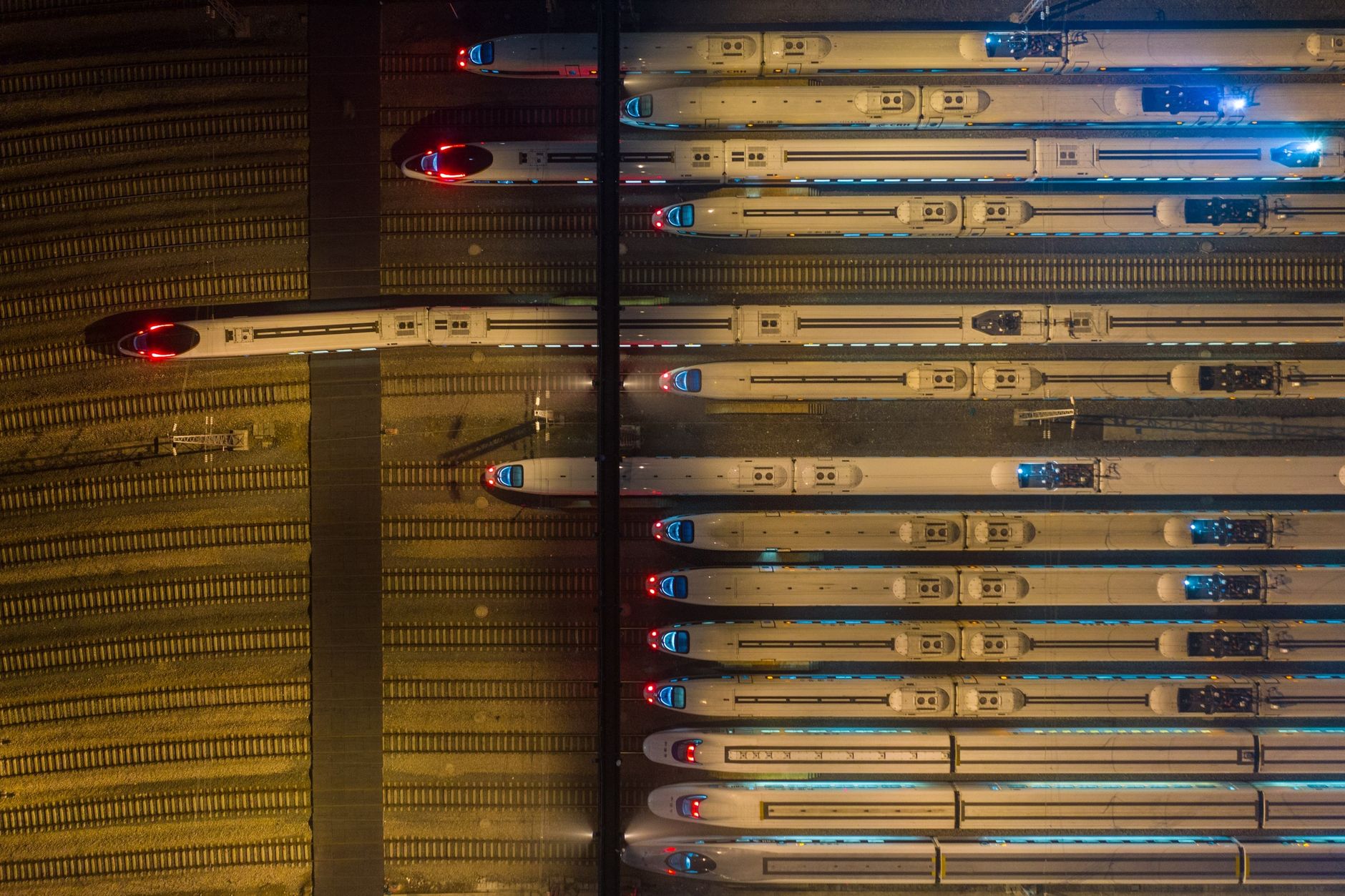
A 10-12 day high-speed rail loop from Beijing to Xi'an to Shanghai to Hangzhou covers China's top sights with no domestic flights. G-trains run at 250-350 km/h; second-class tickets cost 70-700 RMB per leg.
Why Build a Route Around High-Speed Rail
China's high-speed rail network is the world's largest, with over 45,000 km of track in operation as of November 2026. For international travelers, it solves three problems at once: airport transfer time, flight delays, and the sheer scale of the country. A G-train from Beijing to Xi'an takes about 4.5-6 hours from city center to city center, comparable to flying once you factor in airport transit and security lines.
The network is also straightforward to use. Second-class seats recline, legroom is generous, stations are modern, and departures run on time. You watch the countryside shift from northern plains to loess plateau to Yangtze Delta farmland without clearing security twice.
The Classic First-Timer Route: Beijing to Xi'an to Shanghai to Hangzhou
This 10-12 day loop hits the three cities almost every first-time visitor wants: Beijing for imperial history, Xi'an for the Terracotta Army, Shanghai for the modern skyline, and Hangzhou for a quieter finish. Every leg is served by direct G-trains.
Beijing: Days 1-3
Fly into Beijing Capital (PEK) or Daxing (PKX). Spend three days on the Forbidden City, Temple of Heaven, Summer Palace, and a section of the Great Wall. Mutianyu is the most manageable section for crowds and access. Eat Peking duck at Siji Minfu or Quanjude.
Beijing to Xi'an: Day 4
Take a G-train from Beijing West Station to Xi'an North Station. Journey time is 4.5-6 hours depending on the specific service. G-trains on this route run from early morning to late afternoon. Second-class fare is approximately 515 RMB, first class about 825 RMB, and business class around 1,630 RMB (prices as of November 2026; re-check on 12306 before booking).
Book a morning departure around 8:00-9:00 AM. You arrive in Xi'an by early afternoon with time to settle in and walk the Muslim Quarter that evening.
Xi'an: Days 4-6

Xi'an's headline attraction is the Terracotta Army, a 40-minute bus or taxi ride east of the city. Budget a full morning there. In the city itself, rent a bicycle on the Ming-dynasty city wall (the ride takes about 1.5 hours at a relaxed pace), visit the Big Wild Goose Pagoda, and eat yangrou paomo (mutton soup with torn flatbread) and roujiamo (Chinese hamburger) in the Muslim Quarter.
Xi'an to Shanghai: Day 7
Take a G-train from Xi'an North to Shanghai Hongqiao. Journey time is 6-7 hours. Second-class fare is approximately 660 RMB. Trains depart throughout the day; a mid-morning departure gets you to Shanghai in time for dinner.
If you want to break the journey, consider stopping in Luoyang (about 1.5 hours from Xi'an North) to visit the Longmen Grottoes, then continuing to Shanghai the next day. This adds one day to the itinerary.
Shanghai: Days 7-10
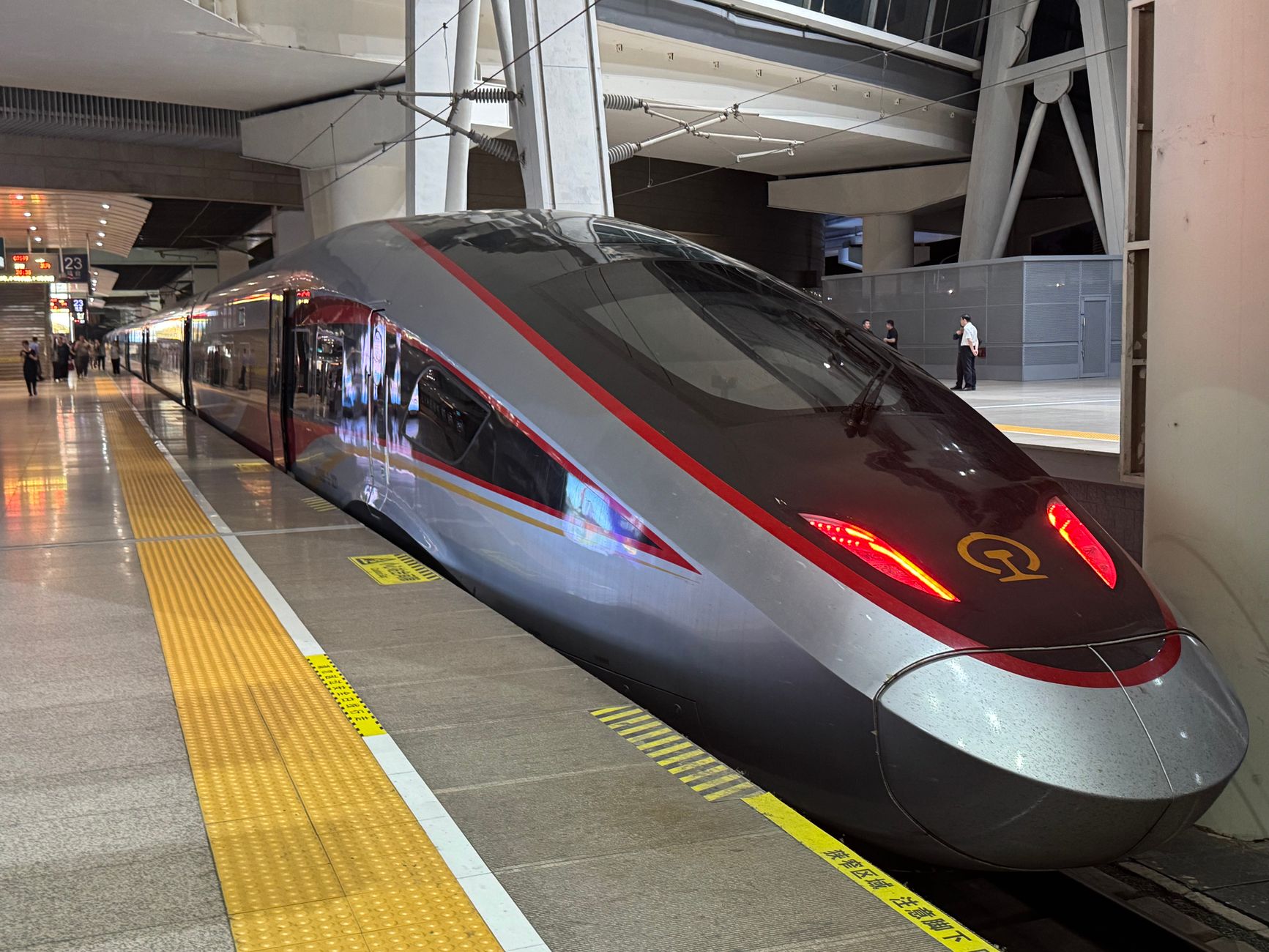
Shanghai Hongqiao Station connects directly to Metro Lines 2 and 10, so you can reach central Shanghai hotels within 30-40 minutes. Spend your days on the Bund, in Yu Garden, along Nanjing Road, and at the Shanghai Museum. An evening Huangpu River cruise shows the skyline from the water.
Optional: Shanghai to Hangzhou Day Trip or Overnight
Hangzhou is 45-60 minutes from Shanghai Hongqiao by G-train. Second-class fare is about 73 RMB. West Lake is the centerpiece: you can walk the 15 km perimeter in about 3 hours or take a boat across. Lingyin Temple and the tea villages around Longjing are worth a half-day each.
Many travelers do Hangzhou as a day trip from Shanghai. If you have an extra day, stay overnight. The lake is quieter in the early morning before the tour groups arrive.
How to Buy High-Speed Rail Tickets as a Foreigner
The Official Channel: 12306
China Railway's official booking site is 12306.cn, and the app is called Railway 12306. As of November 2026, both the site and app support English. You register with your passport number. Tickets open for sale 15 days before departure at 8:00 AM Beijing time. During peak travel periods (Spring Festival, National Day holiday, summer holidays), popular routes sell out within minutes of release.
Third-Party Platforms
Trip.com sells train tickets with an English interface and charges a small booking fee. This is often easier for first-time visitors because the interface is familiar and customer service operates in English. HXXC Travel can also include train tickets in a tour package, which removes the booking step entirely and gives you one point of contact for your whole trip.
What You Need at the Station
- Your passport is your ticket. China Railway uses e-tickets; there is no paper ticket to collect. Your passport is scanned at the gate.
- Arrive 40-60 minutes before departure the first time. Stations are large, and finding the right waiting hall takes longer than you expect.
- Security screening is mandatory at station entry. Allow time for the bag check.
- G-trains have assigned seats. Your carriage and seat number are on your booking confirmation.
- Food is available on board (boxed meals, snacks, hot water for instant noodles) and at station kiosks. Payment is by Alipay or WeChat Pay; cash is rarely accepted on board as of November 2026.
Station-to-City Transfers on the Classic Route
One advantage of high-speed rail over flying is that HSR stations are often closer to city centers, but not always. Here are the key transfers:
- Beijing West: Metro Lines 9 and 7. About 30-40 minutes to central Beijing hotels. Taxi 30-50 RMB depending on traffic.
- Xi'an North: Metro Lines 2 and 4. About 45 minutes to the Bell Tower area. Taxi 60-80 RMB.
- Shanghai Hongqiao: Metro Lines 2 and 10. About 30-45 minutes to the Bund area. Taxi 50-70 RMB.
- Hangzhou East: Metro Lines 1 and 4. About 30 minutes to West Lake. Taxi 30-50 RMB.
A Southern Alternative: Guangzhou to Guilin to Changsha to Shanghai
If you have already seen Beijing and Xi'an, or if you prefer a route through southern China, consider this 10-day loop starting from Guangdong, HXXC Travel's home province.
Guangzhou: Days 1-2
Fly into Guangzhou Baiyun International (CAN). Eat dim sum at a traditional teahouse (Tao Tao Ju or Lian Xiang Lou), walk Shamian Island, and visit the Chen Clan Ancestral Hall.
Guangzhou to Guilin and Yangshuo: Day 3
Take a G-train from Guangzhou South to Guilin North or Yangshuo Station. Journey time is about 2.5 hours. Second-class fare is approximately 140-160 RMB. The karst landscape along the Li River is the draw: take a Li River cruise from Guilin to Yangshuo (about 4 hours on the boat) or rent a scooter in Yangshuo to explore the countryside.
Guilin to Changsha: Day 5
G-train from Guilin North to Changsha South, about 3 hours. Second-class fare approximately 290 RMB. Changsha is known for its spicy Hunan cuisine, the Yuelu Mountain academy, and a growing craft beer scene.
Changsha to Shanghai: Day 7
G-train from Changsha South to Shanghai Hongqiao, about 4-5 hours. Second-class fare approximately 480 RMB.
Practical Tips for First-Time Rail Travelers
Booking Windows and Timing
Tickets go on sale 15 days before departure at 8:00 AM Beijing time for most stations. For popular routes during holidays, book on the day they open. For off-peak travel, same-week booking is usually fine.
Seating Classes
- Second class: 3+2 seating, reclining, generous legroom. The standard choice for most travelers.
- First class: 2+2 seating, more space, roughly 60-70% more expensive than second class.
- Business class: 1+2 or 1+1 seating, lie-flat seats, includes meals. About 3x second-class price.
Luggage
Each passenger can bring up to 20 kg in second class or 25 kg in first or business class, with total dimensions not exceeding 160 cm. Overhead racks fit standard suitcases. Larger bags go in the luggage racks at the end of each carriage.
Payment and Connectivity
- Set up Alipay and WeChat Pay and link them to a foreign bank card before arriving in China. Cashless payment is near-universal as of November 2026.
- Download a VPN before arrival if you need access to Google, WhatsApp, Instagram, or other blocked services. Install it before you cross the border.
- Some G-trains offer free Wi-Fi, but coverage is spotty and login may require a Chinese phone number. Download entertainment in advance.
Budget Snapshot for the Classic Route
For one person, 10 days on the Beijing-Xi'an-Shanghai-Hangzhou route, mid-range hotels:
- Domestic high-speed rail (all legs combined): approximately 1,250 RMB in second class (about 175 USD)
- Hotels (3-star to 4-star): 400-800 RMB per night (about 55-110 USD)
- Food: 150-300 RMB per day (about 20-40 USD)
- Attraction tickets: 500-800 RMB total (about 70-110 USD)
- Total per person excluding international flights: approximately 8,000-12,000 RMB (about 1,100-1,650 USD)
HXXC Travel can arrange this route as a private tour with hotels, train tickets, transfers, and English-speaking guides. Contact us for a quote tailored to your dates and hotel preferences.
FAQ
How far in advance can I book China high-speed rail tickets?
Tickets go on sale 15 days before departure as of November 2026. During peak periods like Spring Festival and National Day holiday, book as early as possible because popular trains sell out within minutes. Re-check the 12306 site for the current booking window before your trip, as policies can change.
Can foreigners buy China train tickets online?
Yes. Register on 12306.cn with your passport number, or book through Trip.com for an English-language interface. HXXC Travel can also include train tickets in a tour package so you do not need to navigate the booking system yourself.
Do I need to collect a paper ticket at the station?
No. China Railway uses e-tickets. Your passport is scanned at the departure gate; there is no paper ticket to collect. Bring your passport and a screenshot of your booking confirmation.
How fast are China's high-speed trains?
G-trains run at 250-350 km/h. D-trains run at 200-250 km/h. On the Beijing-Xi'an route, G-trains complete the roughly 1,200 km journey in 4.5-6 hours.
Is it cheaper to fly or take the train in China?
For routes under 1,000 km, the train is usually competitive with or cheaper than flying. For longer routes like Beijing to Shanghai or Xi'an to Shanghai, train and flight prices are comparable, but the train saves airport transit time. Budget airlines sometimes undercut train prices but add baggage fees and airport transfer costs.
What happens if I miss my train in China?
You can change to a later departure on the same route at the station ticket counter, subject to availability. A change fee applies, typically 20% of the ticket price. This is one reason to arrive at the station 40-60 minutes early, especially on your first trip.
Can I take large luggage on Chinese high-speed trains?
Yes. The allowance is 20 kg in second class and 25 kg in first or business class, with total dimensions not exceeding 160 cm. Overhead racks fit standard suitcases. Larger bags go in end-of-carriage luggage racks.
Is there Wi-Fi on Chinese high-speed trains?
Some G-trains offer free Wi-Fi, but coverage is spotty and the connection may require a Chinese phone number to log in. Cell signal is generally good along major routes. Download entertainment before your trip to be safe.
Related private tours
- Best Of China — 20-Day Private Tour — 20 days
- Six Cities, One China — 15-Day Family Circuit — 15 days
- Grand China Odyssey — 19 Days Cross-Country — 19 days · From US$2,450