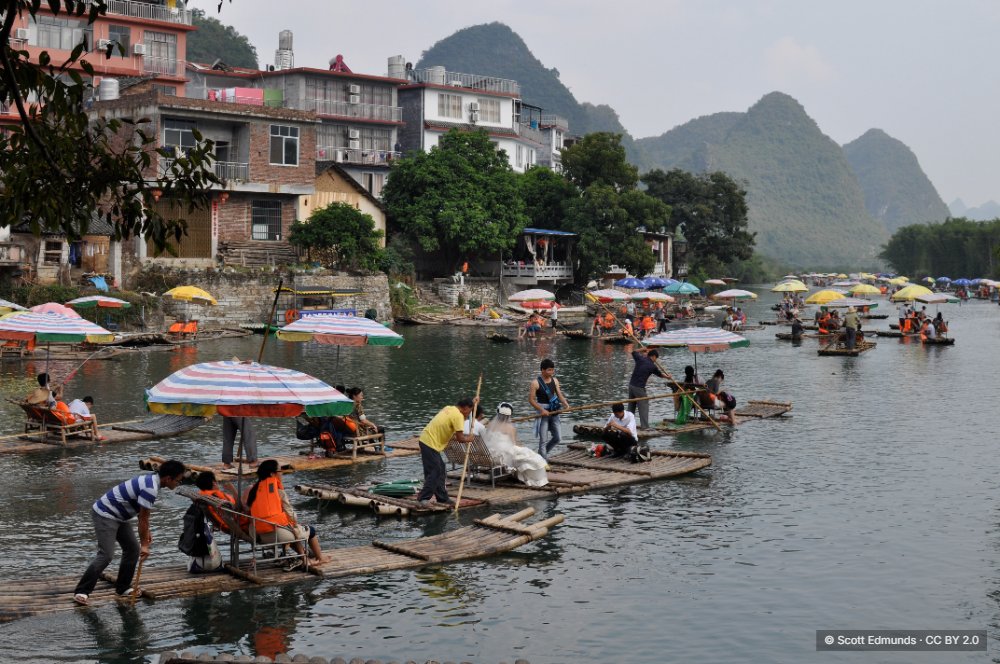
The optimal 3–5 day Guilin and Yangshuo trip combines a Li River cruise to Yangshuo, karst countryside exploration, and a day trip to the Longji Rice Terraces, with the best visiting months falling between April and October.
This guide, reviewed and updated by HXXC Travel’s on-the-ground Guangxi tour team as of November 2026, includes verified pricing, transport details, entry rules, and itinerary recommendations for first-time international visitors. All time-sensitive details should be re-checked immediately before travel, as policies and ticket prices can change without public notice.
Key facts at a glance
- Guilin is located in northeast Guangxi Zhuang Autonomous Region, roughly 480km northwest of Guangzhou, with high-speed rail connections to most major southern China cities.
- As of November 2026, the standard full-length Li River cruise from Guilin’s Zhujiang or Mopanshan Pier to Yangshuo takes 4–4.5 hours, with ticket prices ranging from 215–360 RMB per person depending on seat class.
- Longji Rice Terraces sit roughly 80km north of Guilin’s city center, with a 2–2.5 hour one-way drive from downtown Guilin.
- As of November 2026, citizens of 50 countries qualify for 30-day visa-free entry to China for tourism, making short Guilin/Yangshuo trips accessible without advance visa applications for eligible nationalities.
- Guilin Liangjiang International Airport is 28km from downtown Guilin, with direct flights to 10 international destinations across Southeast Asia and East Asia, plus domestic connections to all major Chinese cities.
- The core Yangshuo visitor area sits along the Li River and West Street, with most countryside attractions located 5–15km outside the town center.
Best time to visit Guilin and Yangshuo
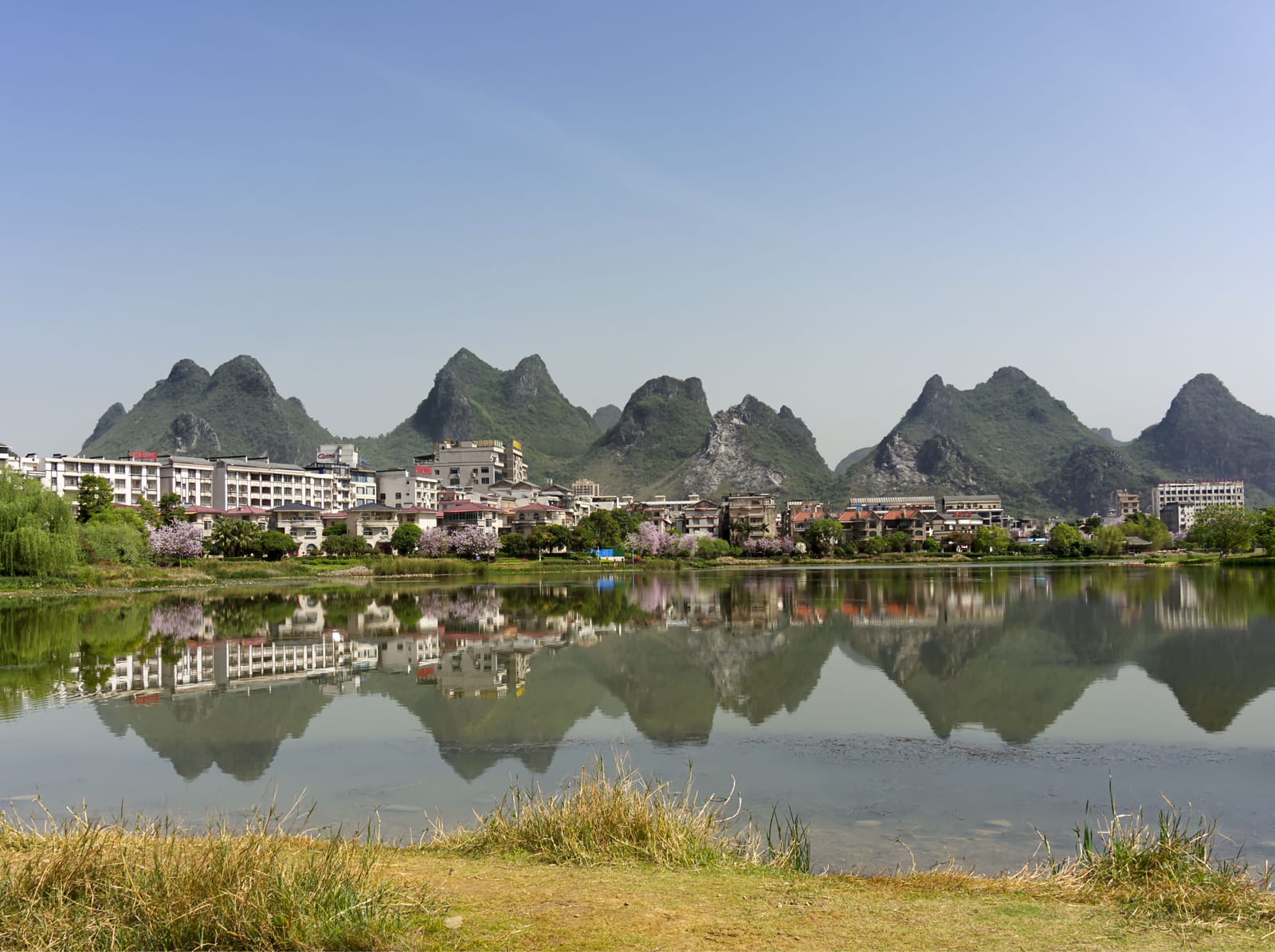
The best time to visit Guilin and Yangshuo is April–June and September–October, when daytime temperatures range 18–28C, rainfall is moderate, and karst peaks are often framed by soft mist that matches the region’s classic landscape paintings. April to early June brings the greenest rice paddy growth across both Yangshuo’s countryside and the Longji terraces, while late September to early October brings clear, low-humidity days ideal for hiking and cycling.
July and August are the hottest and wettest months, with daytime highs regularly reaching 33–35C and occasional heavy rain that can cause Li River water level fluctuations leading to short cruise suspensions. Mid-October to early November brings golden harvest conditions at Longji, with thinner crowds and lower accommodation prices across Yangshuo once China’s National Day holiday period ends in early October, though river water levels are lower and some shallow bamboo raft routes may be closed.
Winter (December–February) is the quietest season, with temperatures dropping to 5–12C, occasional light frost at higher terrace elevations, and the lowest hotel and tour prices of the year.
How to get to Guilin and Yangshuo
Most international travelers arrive in Guilin first, either by direct flight, high-speed rail, or connecting flight from a major Chinese entry hub like Guangzhou, Shanghai, or Beijing.
Guilin Liangjiang International Airport is 28km from downtown Guilin, with a 40-minute airport bus ride (20 RMB per person) to the city center, or metered taxi fares of 80–100 RMB. As of November 2026, there are no direct long-haul flights from North America, Europe, or Oceania to Guilin; most international visitors connect via Guangzhou (1 hour flight time) or Hong Kong (1.5 hour flight time).
High-speed rail is the most reliable transport option for travelers coming from other parts of southern China. Guilin has three main high-speed rail stations: Guilin Station (closest to downtown), Guilin North Station, and Guilin West Station. Direct high-speed trains connect Guilin to Guangzhou South in 2 hours 40 minutes (175 RMB second class), to Shenzhen North in 3 hours 10 minutes (212 RMB second class), to Changsha South in 3 hours, and to Kunming South in 4.5 hours.
To travel between Guilin and Yangshuo, visitors can take the 4–4.5 hour Li River cruise directly to Yangshuo’s dock, take a 1 hour high-speed train from Guilin Station to Yangshuo Station (30 RMB second class, followed by a 20 minute bus ride to Yangshuo town center for 20 RMB), or take a private car transfer in roughly 1.5 hours for 200–250 RMB per vehicle.
Top experiences and itinerary planning
Li River cruises
The Li River cruise is the core Guilin experience, traveling 83km downriver from Guilin’s Zhujiang or Mopanshan Pier to Yangshuo’s Shuidongmen Pier, passing iconic karst formations including Nine Horses Fresco Hill and Yellow Cloth Shoal, the landscape printed on the 20 RMB banknote.
As of November 2026, there are two main cruise options: the standard 4.5 hour cruise with a simple Chinese-style buffet lunch, departing daily between 8:30am and 9:30am, with 215 RMB economy seats on the lower deck and 360 RMB premium seats on the upper deck with unobstructed views. Shorter 2 hour bamboo raft trips operate on the quieter stretch of the Li River between Yangdi and Xingping, for 120–180 RMB per person, though these do not run if river water levels are too high or too low.
Yangshuo countryside exploration
Yangshuo’s flat, paddy-lined countryside is made for slow exploration, with paved cycling paths running between karst peaks, small villages, and riverbanks. Most visitors rent a bicycle (20–30 RMB per day) or electric scooter (50–60 RMB per day) to ride the 15km Yulong River route, stopping at small village stalls for sweet osmanthus tea and local rice noodles. Shorter bamboo raft trips run along the Yulong River, with 1 hour trips starting at 160 RMB per raft (holding 2 people), and no motorized vessels allowed on this stretch of water. Other popular Yangshuo activities include the 1 hour light show Impression Sanjie Liu, directed by Zhang Yimou, with tickets starting at 238 RMB per person as of November 2026, and casual rock climbing on the karst crags outside town, with half-day guided climbs starting at 300 RMB per person.

Longji Rice Terraces day trip
The Longji (Dragon’s Backbone) Rice Terraces are located in Longsheng County, north of Guilin, built by the Zhuang and Yao ethnic communities over 650 years of continuous farming. The terraces cover 66 square kilometers of mountain slopes, rising from 300m to 1100m in elevation, with three main viewing areas: Jinkeng Red Yao Terraces (the largest and most popular with photographers), Ping’an Zhuang Terraces, and Longji Old Village.

A typical day trip from Guilin departs at 8am, arriving at the terrace parking area by 10:30am, with 2–3 hours of hiking between viewing points, a lunch of local bamboo rice and sour pork at a village home stay, and a return drive to Guilin or Yangshuo by 5pm. As of November 2026, Longji entry tickets cost 80 RMB per person, with optional cable car rides to the highest Jinkeng viewpoint costing 55 RMB one way or 100 RMB round trip. Visitors with more time can stay one night in a village guesthouse (200–400 RMB per night) to catch sunrise over the terraces, with fewer crowds than the midday day trip window.
Most first-time visitors plan a 4 day trip that follows this structure:
- Day 1: Arrive in Guilin, visit Elephant Trunk Hill park and Two Rivers and Four Lakes scenic area in the city, stay overnight in Guilin.
- Day 2: Take the morning Li River cruise to Yangshuo, explore West Street in the evening, stay overnight in Yangshuo.
- Day 3: Cycle the Yulong River route, take a short bamboo raft trip, return to Guilin in the evening.
- Day 4: Join a guided day trip to Longji Rice Terraces, return to Guilin for departure, or extend one night in Longji for sunrise views.
Local food to try
Guilin and Yangshuo’s food draws on Zhuang, Yao, and Han culinary traditions, with sour, savory, and lightly spicy flavors common across most dishes. Dishes to prioritize include:
- Guilin rice noodles: The region’s signature staple, served for breakfast across every local eatery, with rice noodles in a slow-simmered pork and beef broth, topped with pickled beans, peanuts, and sliced braised meat, for 8–15 RMB per bowl.
- Beer fish: A Yangshuo specialty made with fresh Li River carp, braised in local Li River beer, tomatoes, garlic, and green peppers, served family-style for 60–80 RMB per portion for two people.
- Bamboo rice: Glutinous rice steamed inside a hollow bamboo tube with cured pork and mushrooms, a staple of the Longji terrace villages, for 15–20 RMB per tube.
- Oil tea: A traditional Yao and Zhuang drink made from fried tea leaves, ginger, and rice, served with salty fried snacks, often offered to guests in Longji village homes.
- Osmanthus cake: A sweet, soft pastry made with local osmanthus flowers and glutinous rice flour, sold at street stalls across Guilin and Yangshuo for 5–10 RMB per piece.
Practical tips for international visitors
As of November 2026, citizens from 50 countries (including the United Kingdom, Canada, Australia, New Zealand, and most EU member states) qualify for 30-day visa-free entry to China for tourism, business, or family visits, meaning eligible travelers do not need to apply for a visa in advance for short Guilin and Yangshuo trips. Travelers who are not eligible for visa-free entry, or who plan to stay longer than 15 days, should apply for a standard L tourist visa at their nearest Chinese consulate before departure. All entry rules are subject to change, so re-confirm the latest visa policy on China’s National Immigration Administration website in the week before your trip.
Payment in Guilin and Yangshuo is primarily via mobile payment apps, but most hotels, larger restaurants, and ticket offices accept major international credit cards as of 2026. It is advisable to carry 500–1000 RMB in cash for small purchases at village stalls, bamboo raft operators, and local noodle shops that do not accept cards.
English is spoken at most large hotels, major tourist ticket offices, and popular restaurants in Yangshuo, but very few local drivers, small shop owners, or village residents in Longji speak English. First-time visitors who are not comfortable using translation apps and navigating public transport may prefer a pre-booked private tour with an English-speaking guide; HXXC Travel, a Jiangmen-based inbound China tour operator, runs fixed-departure and private Guilin/Yangshuo/Longji itineraries starting from 1,890 RMB per person for a 4 day trip, including transport, English-speaking guide, entry tickets, and accommodation.
Tap water is not safe to drink across Guilin and Yangshuo; bottled water is available for 2–3 RMB per 500ml bottle at all convenience stores. Summer months bring strong sun and occasional mosquitoes in the countryside, so pack sunscreen, insect repellent, and sturdy walking shoes for terrace hikes and cycling trips.
Frequently asked questions
How long can I stay in China visa-free to visit Guilin?
As of November 2026, eligible passport holders from 50 listed countries can stay in China for up to 30 days visa-free for tourism, which covers the full length of a typical 3–5 day Guilin and Yangshuo trip. You do not need to apply for a visa in advance, but you must hold a passport valid for at least 6 months beyond your planned departure date from China, and have a confirmed outbound travel ticket. Re-check the latest eligible country list and policy rules before booking, as visa-free policies are updated periodically.
How much does a Li River cruise cost in 2026?
As of November 2026, the standard full-length Li River cruise from Guilin’s Zhujiang or Mopanshan Pier to Yangshuo costs 215 RMB per person for lower-deck economy seats with a buffet lunch, and 360 RMB per person for upper-deck premium seats with unobstructed window views. Shorter 2-hour Li River bamboo raft trips between Yangdi and Xingping cost 120–180 RMB per person, and 1-hour Yulong River bamboo raft trips in Yangshuo cost 160 RMB per 2-person raft. Prices do not include transport to and from the pier.
How many days do I need for Guilin and Yangshuo?
Most first-time visitors need 3 full days to cover the core experiences: one day for the Li River cruise and Yangshuo exploration, one day for cycling or rafting in Yangshuo’s countryside, and one day for a Longji Rice Terraces day trip. Travelers who want to add extra activities like rock climbing, cooking classes, or a sunrise stay at Longji should plan for 4–5 full days in the region. It is not recommended to try to visit Guilin and Yangshuo on a day trip from Guangzhou or other nearby cities, as transport time will leave too little time to experience the main sites.
Are Longji Rice Terraces worth the day trip from Guilin?
Longji Rice Terraces are worth the 2–2.5 hour drive from Guilin for travelers interested in rural ethnic minority culture, landscape photography, and hiking. The terraces offer a distinct experience from the river and karst scenery of Guilin and Yangshuo, with structured hiking paths, home-cooked village meals, and views of layered farmland across mountain slopes. Travelers with very tight itineraries (2 days or fewer in the region) may skip Longji to avoid long drive times, but all 4+ day itineraries should include the trip.
Related private tours
- Southern Scenery — Guilin, Yangshuo & Dragon's Backbone — 6 days · From US$450
- Best of China — 19-Day Private Tour — 19 days · From US$2,450
- 25-Day China Cross-Country Travel Itinerary — 25 days