
The Quick Answer for Visitors
If you are invited to a Chinese wedding or a family home during your trip, the safe formula is simple: dress modestly, bring cash in a red envelope, let elders be seated and served first, and follow your host's lead on toasts and tea. Guests are never expected to know the rituals — arriving on time, eating generously, and toasting politely covers almost everything. The notes below reflect common practice across mainland China as of November 2026; customs vary by region and family, so re-confirm details with your host or your HXXC Travel contact close to your travel date.

What Actually Happens at a Modern Chinese Wedding
Legal marriage in China is registered at a district civil affairs bureau, often weeks or months before the party. Many couples queue for auspicious dates — May 20 (read as 5-2-0, which sounds like 'I love you' in Mandarin) and Qixi, the seventh day of the seventh lunar month, are so popular that registration offices are crowded and some extend hours.
The banquet, not the registration, is the real social event. A typical day runs like this:
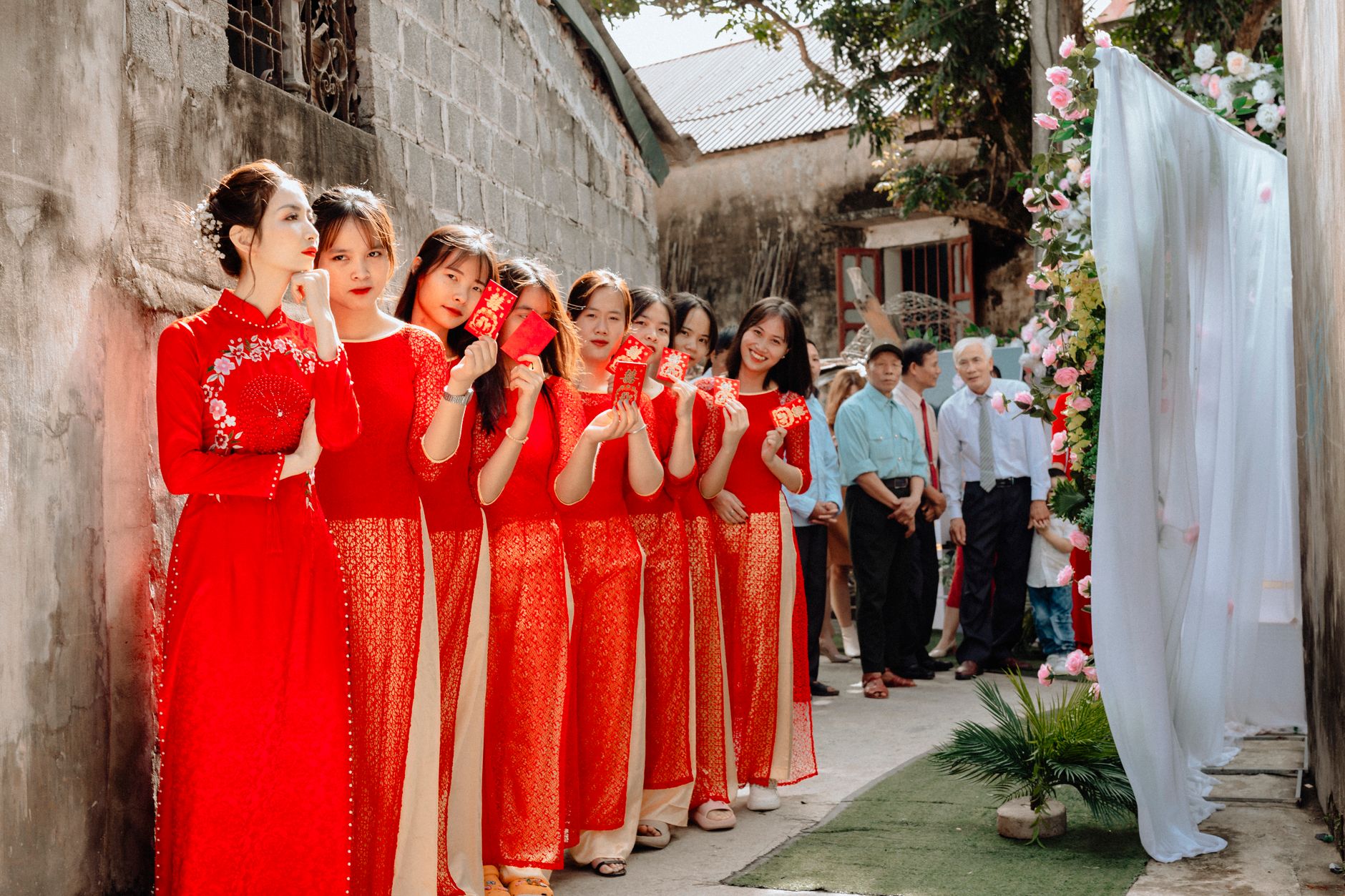
- Morning: the groom and his groomsmen arrive at the bride's home and must pass 'door games' set by the bridesmaids — singing, small challenges, and red packets to buy their way in.
- Late morning or early evening: guests arrive 20-30 minutes before the posted time and hand a red envelope at the sign-in table.
- Banquet: a professional emcee runs the entrance procession, speeches, and often a ring exchange; eight to twelve courses follow, frequently ending with a whole fish or a sweet soup depending on the region.
- Outfit changes: most brides appear in a white Western gown, change into a red qipao or xiuhe suit for the tea ceremony, then a third gown for the farewell. The room tends to empty during each change — a good moment for a break.
Some families avoid scheduling weddings during the seventh lunar month (Ghost Month) or on dates a family elder rules out; many city couples now ignore this. In Guangdong, where HXXC Travel is based, banquets lean on roast suckling pig, steamed fish, and slow-cooked soup; northern weddings often run longer and include more ritual at the bride's family home.
Red Envelopes: How Much Cash to Bring
A cash gift in a red envelope (hongbao) is the standard wedding present; physical gifts are not expected. A few rules keep you safe:
- Use even numbers: 200, 600, 800, 1,000, and 1,200 RMB are all normal amounts. Never use a number containing 4 — it sounds like 'death' in both Mandarin and Cantonese — so 400 is out despite being even.
- Scale to the city and the relationship. In first-tier cities close friends often give 800-1,200 RMB or more; 200-600 RMB is a reasonable, respectful range for a foreign guest invited by a colleague or friend.
- Ask a bank for crisp new bills a day or two ahead; old, folded notes read as an afterthought.
- Hand the envelope to the relative at the sign-in desk, who records your name in a gift ledger (lijin) so the couple can reciprocate at your future events. Do not hand cash casually across a table.
- Never open a red envelope in front of the giver — this applies to any envelope you receive, too.
- WeChat digital red envelopes are now the norm for small favors and holidays, but a wedding still calls for a physical envelope.
The Tea Ceremony and How Chinese Families Are Organized
The tea ceremony is the moment the two families formally connect, and it usually carries more emotional weight than the legal registration. The couple serves tea to parents, grandparents, and senior relatives in order of seniority — kneeling at traditional weddings, standing at modern ones. Elders sip, then return gold bracelets, necklaces, or red envelopes to the couple. Guests watch; only family takes part.
For travelers, the practical takeaway is how Chinese people address each other. People are called by relationship, not name, and this extends to strangers:
- Ayi (auntie) and shushu (uncle) for your friend's parents or any middle-aged person helping you.
- Yeye and nainai for grandfathers and grandmothers.
- Gege and jiejie (older brother, older sister) for slightly older strangers — calling a young shop assistant jiejie is ordinary politeness, not flirting.
- Shifu for drivers, technicians, and skilled workers.
Elders come first in practice: they are seated first at round tables, served the best pieces of fish, and toasted first. Chinese names put the family name first, so in the name Li Wei the surname is Li — address the person as Mr Li or Ms Li unless invited to use the given name. Married women keep their surnames, so a mother and child on the same booking may legitimately have different last names; do not assume a mismatch is an error.

Visiting a Chinese Home: Guest Etiquette
If a Chinese friend or homestay host invites you home, take it seriously — many families only host close friends. Arrive with a small gift: good tea, seasonal fruit, pastries, or something typical of your home country. Red or gold wrapping is a plus.
- Remove your shoes at the door; slippers will appear within seconds.
- Expect to be over-fed. Hosts add dishes faster than you can empty them; trying everything matters more than finishing. Leaving a small amount is fine and will not offend.
- When someone pours tea for you, tap two bent fingers on the table — a gesture said to come from a Qing dynasty emperor traveling incognito, now standard thanks in Guangdong teahouses and beyond.
- Compliment at least one dish by name and ask for a second serving of it. This pleases hosts more than any souvenir.
- Never stand your chopsticks upright in a bowl of rice — it resembles incense burned for the dead. Also avoid pointing with chopsticks or spearing food.
- Ask before photographing family members, especially elders; most will happily pose once asked.
If your itinerary with HXXC Travel includes a home-hosted meal in Guangdong, your guide will brief you on that family's habits — whether they speak Cantonese, whether drinking is expected, and how much English the children speak.
Gifts and Gestures to Avoid
Gift taboos are homophone-based and taken seriously by older relatives. Skip these, even as well-meant souvenirs:
- Clocks: 'giving a clock' (song zhong) sounds identical to attending a deathbed funeral.
- Pears: li sounds like 'separation' — and never split a single pear between two people.
- Umbrellas: san sounds like 'to scatter or part ways'.
- Shoes: xie is a near-homophone for 'evil', and shoes imply the recipient walks away.
- Handkerchiefs: associated with tears and farewells.
- Green hats for men: the recognized symbol of a cheated-on husband.
- White or yellow chrysanthemums and white wrapping: funeral flowers and colors.
- Sets of four of anything: the same 'death' problem; prefer six or eight.
- Knives and scissors: said to cut the relationship.
Invited to a Wedding? A Simple Guest Checklist
- RSVP early and confirm by phone or WeChat; tables are planned by headcount, and even no-shows are expected to send their envelope.
- Wear smart casual to semi-formal. Avoid white (the standard bridal color now), skip head-to-toe black at traditional weddings, and leave red to the couple.
- Bring your hongbao with your name written on it and hand it in at the sign-in desk on arrival.
- Sit only at your assigned table; seating reflects family politics you cannot see.
- When toasting, hold your glass slightly lower than the elder's rim. You may be toasted with baijiu, but sipping, or toasting with tea or juice, is fully acceptable — no one can force a foreign guest to ganbei.
- Stay through the main courses, roughly two hours; many guests leave before the final dishes and this is normal.
- Take photos from your seat but stay clear of the hired photographer's angles.
FAQ
How much money should a foreign guest give at a Chinese wedding?
Most foreign guests give 200-600 RMB in a red envelope, depending on closeness and city; close friends in Beijing, Shanghai, or Guangzhou often give 800-1,200. Use even numbers, avoid any 4, and bring crisp new notes.
What should you not give as a gift in China?
Avoid clocks, pears, umbrellas, shoes, handkerchiefs, green hats, white chrysanthemums, sets of four, and sharp objects like knives. Each carries a homophone or symbolic link to death, separation, or bad luck.
Can foreigners take part in a Chinese tea ceremony?
Only family members serve and receive tea, so guests watch rather than take part. If a family treats you as honorary family, accept tea with both hands and a slight nod — that is all the etiquette required.
Is it rude to refuse alcohol at a Chinese banquet?
No. Citing health, medication, or driving is widely accepted, and toasting with tea, juice, or soda is standard practice. Raise your glass for every toast and take at least a sip.
Why do Chinese couples line up to register marriage on May 20?
Read as 5-2-0, the date sounds like wo ai ni ('I love you') in Mandarin, making it one of the busiest marriage registration days of the year alongside Qixi. Civil affairs offices often extend hours and issue queue tickets on those dates.